
 Grounding leadership practice in self-reflection for real‑world application
The Dynamic Leadership Certificate program at the University of Delaware’s Division of Professional and Continuing Studies (UD PCS) emphasizes a powerful truth: effective leadership begins long before strategy, influence or decision-making. It starts with awareness, the foundation for leading self, leading teams and leading organizations in today’s complex environments.
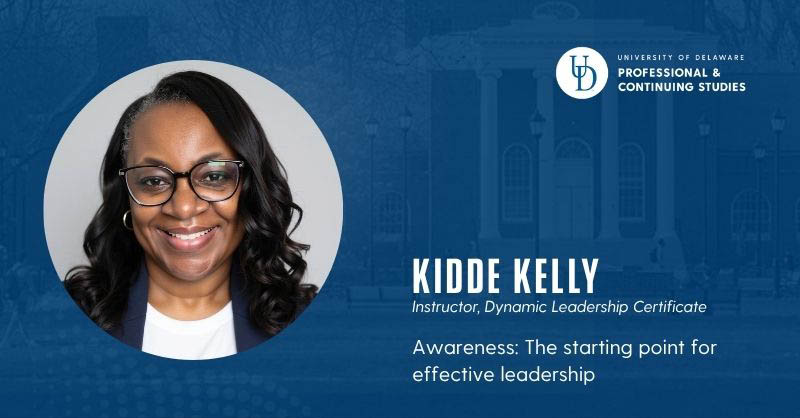
Kidde Kelly, an instructor in the program, brings this emphasis on awareness into her teaching through her broader leadership philosophy. Drawing from an inclusive leadership model that she developed, Kelly views leadership as something defined not by title or authority, but by how leaders show up every day. As she explains, “ALL IN is about leading with awareness, growing learning agility, owning your impact through leadership accountability and pairing inclusion with action.”
Awareness, she notes, goes far beyond surface-level self-reflection. “It’s not just about knowing yourself today,” Kelly says. “It’s about understanding where you are, where you’re trying to go and being willing to learn new ways of getting there.” Leaders who cultivate this kind of awareness gain the ability to respond rather than react, connect rather than command and lead with purpose rather than habit.
In the Dynamic Leadership program, “leading self” begins with awareness. Participants are asked to reflect deeply on their values, behaviors and blind spots and how those elements shape their leadership identity. “Until you really know what you value and where your blind spots are, you’re likely to run into roadblocks without realizing it and,” Kelly explains. “that’s where leaders unintentionally step into landmines. Awareness helps you avoid that.”
Kelly emphasizes that awareness is not a one-time exercise, but an ongoing practice. “People change over time and life experiences shift how we show up,” she says. “The core of who you are stays the same, but your self-awareness of how you’re leading today has to be revisited regularly if you want to be an authentic, inclusive leader.”
As part of UD PCS leadership programs, participants are encouraged to pause and reflect on questions such as:
- How am I contributing to the environment around me?
- What impact do my actions have on others?
- Where can I grow next?
According to Kelly, one question rises above the rest. “The most important question leaders need to ask themselves is: ‘How am I showing up today?’” she says. “Once you know that, you can change your trajectory. But without that awareness, there’s no clear path forward.”
That pause — intentional and reflective — is where growth begins. From there, learning agility takes hold, allowing leaders to align their values with organizational goals while meeting people where they are. Kelly emphasizes that inclusive leadership is central to this process. “Inclusion means valuing lived experiences and creating space for every voice to be heard,” she says. “Belonging happens when leaders nurture those connections and lead with humanity and intention. Leaders need to meet their teams where they are, in ways that best support their growth.”
The Dynamic Leadership Certificate program is designed to help emerging and experienced leaders build the self-understanding necessary to support, inspire and elevate the people they serve. Through applied learning, reflection and real‑world practice, the program prepares leaders to navigate today’s dynamic challenges with greater clarity, accountability and purpose.
Awareness may be the starting point, but its value is realized through action. That progression is reflected in the experience of Julie Harris, a Dynamic Leadership Certificate participant who applied program frameworks to elevate team performance, build trust and create alignment across diverse engineering teams.
Kidde Kelly, DBA, is an instructor in the University of Delaware’s Dynamic Leadership Certificate program offered through UD PCS. A strategic human resources executive and leadership practitioner, Kelly brings extensive experience in organizational leadership, inclusive leadership development and applied people strategy into the classroom. She is the creator of the ALL IN leadership model to support inclusive leadership. Through her teaching based on this model, Kelly helps emerging and experienced leaders translate research-based leadership principles into practical, real‑world applications.