
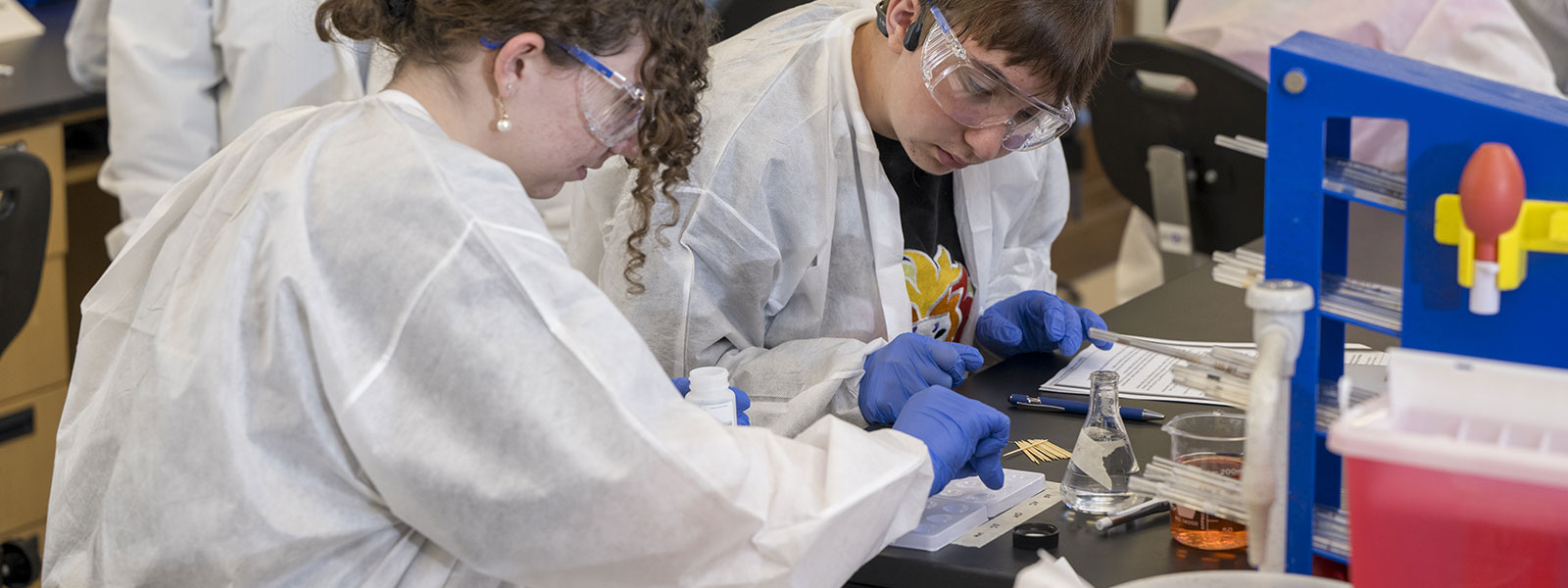
Solve a mystery while you learn the basics of forensic analysis
For high school students, 15 and up, interested in biomedical sciences, laboratory medicine, biotechnology, criminal justice and crime scene investigation
Session 1: June 28–July 2, 2027
Session 2: July 12–16, 2027
University of Delaware | Willard Hall, Main Campus, Newark, Del.
REGISTRATION OPENS DECEMBER 1, 2026.
Program benefits:
- Gain hands-on lab experience, along with site visits to crime investigation units
- Learn from UD forensic experts who work in the field
- Visit crime labs and crime scene investigation units
- Receive a personalized program reference letter for your college application portfolio, plus a digital badge to display on social media or online profiles
Take on the challenges critical to providing evidence that solves a criminal case in this one-week program designed for high school students interested in real-world forensic techniques!
In this noncredit program led by UD faculty and forensic experts from the Department of Medical and Molecular Sciences, students will experience what it’s like to work a crime scene and process evidence in state-of-the-art laboratories at the University of Delaware and off campus. Field trip day is subject to change based on location availability.
Students will work in groups to produce and present “court-ready” reports to a panel of forensic scientists from Delaware’s Division of Forensic Science and the Delaware State Police in the program’s capstone experience.
Explore the Future of Forensic Science
Get a behind-the-scenes look at the University of Delaware’s Forensic Science program in this 2025 video spotlight. Hear from instructors and students as they share how this hands-on, interdisciplinary program prepares professionals to meet the growing demand for forensic expertise in law enforcement, healthcare, cybersecurity and beyond.
Registration and Schedule
Forensic Science Pre-College Summer Program — Noncredit Program
REGISTRATION OPENS DECEMBER 1, 2026.
SCHEDULE:
- Session 1: June 28–July 2, 2027, 9 a.m.-4 p.m., Monday-Friday
- Session 2: July 12–16, 2027, 9 a.m.-4 p.m., Monday-Friday
LOCATION: Willard Hall Education Building, University of Delaware, 16 West Main St., Newark, Del.
PRICE:
- Standard: $1,995 (through June 1)
- Late Registration: $2,200 (after June 1)
REGISTRATION CLOSES: June 7 for Session 1 | June 14 for Session 2
NONCREDIT CONTACT HOURS: 3.0 CEUs | 30 noncredit contact hours
TECHNOLOGY REQUIREMENT: Students must bring their own laptop on Monday, Tuesday, Wednesday and Friday.
ACCOMMODATIONS: Housing is not provided; rooms can be reserved at the Hyatt on Main Street for 20% off through the booking link provided upon registration. At least one guest in each room must be 21 or older.
LUNCH: Students should bring their own lunch or bring funds for local lunch for the first four days of the program. Lunch is provided on the last day of the program.
Financial options available
Only one discount or scholarship award can apply per registration.
DISCOUNTS: A 15% discount is available for dependents of military and veterans, UD employees and UD alumni, or two or more siblings registering from the same family. For details or to receive the discount code, please email continuing-ed@udel.edu.
Pre-college program scholarship info
University of Delaware, Professional and Continuing Studies is committed to making educational opportunities accessible to all students.
Scholarships will be reviewed and awarded based on the degree of demonstrated financial need, in alignment with Federal TRIO guidelines.
Because funding and capacity vary across our different pre-college offerings, scholarship awards are program-specific and may range from partial assistance (e.g., 25% of tuition) up to full program coverage (100%). To secure their enrollment, students awarded a 100% scholarship are required to submit a $100 commitment deposit; this deposit will be fully reimbursed upon the student's successful completion of the program. Priority is given to students who meet federal low-income guidelines, are potential first-generation college students or are currently enrolled in a recognized TRIO program. Awards are strictly need-based and are granted as funding permits.
Pre-college program refund policy
Written cancellation requests must be submitted by email to continuing-ed@udel.edu.
- A full refund, less a $75 processing fee, will be issued for written cancellations received up to 60 days ahead of the program start date.
- A 50% refund, less a $75 processing fee, will be issued for written cancellations received between 59 and 30 days ahead of the program start date.
- No refunds will be issued for withdrawals received after 30 days ahead of the program start date.
The University of Delaware is not responsible for any costs incurred as a result of program cancellation or schedule changes. If this program is canceled by the University, a full refund is provided.
Program Details
Who should participate in this program?
This weeklong noncredit program is designed for high school students (rising high school sophomores, juniors or seniors, 15 and up) with an interest in biomedical sciences, laboratory medicine, biotechnology, criminal justice and crime scene investigation as potential career choices. To participate, students must have credit for at least one high school level biology or general science course.
Safety information
Personal safety equipment (safety goggles/gloves and disposable lab coats and extensive safety training will be provided for students. Long pants and closed-toe shoes (e.g. sneakers) must be worn.
Students in this program may be exposed to mature images, including but not limited to photographs of crime scenes and forensic investigations, which may contain sensitive content. These materials are an essential part of the curriculum and will be used responsibly and with sensitivity. Students may request to step away during the presentation of said material.
Course outline
- Day 1: Crime scene investigation, evidence collection, forensic photography, fingerprinting and impression evidence
- Day 2: Forensic toxicology
- Day 3: Forensic chemistry; DNA analysis, including polymerase chain reaction (PCR) tests
- Day 4: Field trips to Division of Forensic Science in Wilmington and Troop 2 Evidence Unit in Bear. (Field trip destinations are subject to change based on location availability.)
- Day 5: Project presentations and lunch with forensic panelists (lunch provided)
Learner outcomes
Participants will get hands-on experience with:
- Documenting a crime scene and collecting physical evidence
- Using the chemical and immunologic assays common in forensic science
- Applying genetic science essential to DNA profiling
- Calculating the probability of matching DNA profiles
- Performing forensic toxicological analyses
- Using fingerprinting techniques and analysis
- Applying firearms and ballistics data
- Providing courtroom testimony as an expert witness
Instructional team
Anthony C. DiNardo, Automated Fingerprint Identification System (AFIS) section administrator for the Delaware State Police, State Bureau of Identification
Anthony C. DiNardo served as a sworn law enforcement officer for 21 years and as a detective in the Crime Scene Unit in the New Castle County Police Department for 17 years. Following his retirement, he became a forensic latent print examiner for the Delaware State Police and was promoted to AFIS section administrator in 2018.
Jessica Smith, chief forensic toxicologist of the Delaware Division of Forensic Science (DFS)
Jessica Smith manages the operations and staff of the toxicology unit where biological specimens of post-mortem and driving under the influence (DUI) cases are analyzed for drugs and alcohol. The toxicology unit is a team of 11 employees and handles more than 2,100 cases and 9,500 tests per year.
Esther E. Biswas-Fiss, professor and chair of UD’s Department of Medical and Molecular Sciences; director of graduate programs in medical sciences; Director of programs in applied molecular biology and biotechnology in the College of Health Sciences
Esther E. Biswas-Fiss has led the development of undergraduate and master’s biotechnology degree programs at UD, programs accredited by the American Society for Biochemistry and Molecular Biology (ASBMB). Her contributions to research have led to nearly 60 peer-reviewed publications in leading science journals, including Molecular Vision; European Journal of Ophthalmology; Journal of Biological Chemistry; and Biochemistry.
Heather Walters, instructor in the Department of Medical and Molecular Sciences at UD; former director of UD’s minor in forensic science
Heather Walters’ extensive knowledge of sample processing and molecular laboratory techniques comes from her 20 years of work in the clinical laboratory at ChristianaCare and her 17 years of teaching at UD. Her expertise is in medical microbiology.